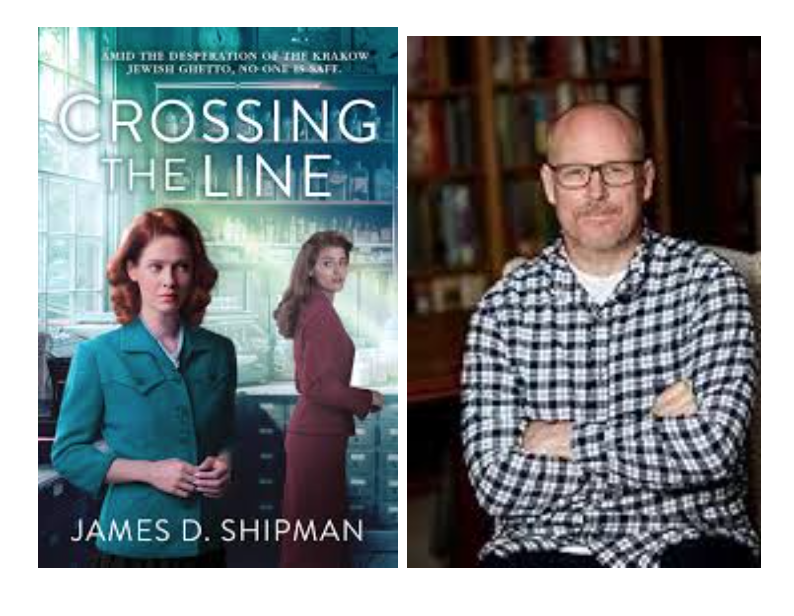
Crossing The Line
James D. Shipman
Kensington Books
December 2025
Crossing The Line by James D. Shipman is an insightful story about the struggles of three women during the Holocaust in the Krakow Jewish Ghetto. The storyline shows how the characters faced betrayals, restrictions, and making impossible choices.
“All the three female assistants in the pharmacy are real people along with Tadeusz Pankiewicz. They were all Polish, living outside the ghetto, yet had the pharmacy inside the ghetto. He was encouraged by the Nazis to move out of the ghetto, but he refused. They worked with the Polish underground, smuggling in food and medicine. With the help of the Jewish Resistance inside the ghetto they hid people, utilizing hair dye and sleeping pills. While two of the main female characters are fictional, The Jewish woman, Natalia Wajeblum and the German woman, Elsa Baumann. I tend not to use real people when I explore their character arc and motivations.”
The three main characters are Natalia, a young Jewish woman from a wealthy family who believed money could get anything including safety; Irena is a Polish pharmacy worker whose boss runs a pharmacy in the ghetto; and Elsa, a German young woman who becomes an SS officer assigned to the ghetto. While the novel centers on the pharmacy, it also shows the worsening in the ghettoes as the Germans decide to deport the Jews for annihilation. The pharmacy, its owner and employees are real people who risked their lives to remain in the ghetto and help Jews while the characters Natalia and Elsa are fictional.
Once deported to the ghetto Natalia’s world falls apart. She finds some solace working in the pharmacy using her medical training.
“I wrote her as someone who realized she was just one more person in this Jewish community that is no better than anybody else and was not going to get special treatment. She was depicted as a feminist, strong-willed, humiliated, helpless as far as street smarts, and snobbish out of ignorance. She was ambitious and selfish.”
Elsa, a young German woman, is recruited by the SS to avoid jail after a deep betrayal. After being assigned to the ghetto she is confronted with the cruelty and violence of her commanders. As restrictions and penalties grow worse each day, Irena, Natalia, and Elsa are drawn toward unexpected alliances and decisions that could save or jeopardize not just their own lives, but the lives of countless others.
“She looked for some kind of purpose and was a conflicted character. She was at the bottom but gained more power in a bad way. I think she and Natalia found redemption at the end of the day. Elsa was a SS guard that represented those from the lower classes or lower middle class that had a rough time in the pre-war years. A lot of them got in trouble by disobeying orders or were criminals. For most of them this was a second chance.”
Irena as a Pole, who was not Jewish, was allowed to cross the ghetto walls, using this opportunity tosmuggle in food, letters, and essential supplies, and tocarry out information and photographs documenting the atrocities.
“I wanted to show the tough decisions those working in the pharmacy had to make. Tadeusz Pankiewicz was the pharmacist who employed three assistants, Irena Drozdzikowska, Helena Krywaniuk, and Aurelia Danek. They were trying to do good and had to overcome their doubts early on if they were doing the right thing. All of them debated if they should leave when told to go. They had a responsibility to Polish and Jewish customers. Yet they decided to stay because they knew they would be the only ones who could provide medicine, supplies, food, and a hiding place for Jews. They were exceptionally brave people. The pharmacy became the place for Jews to meet, plan underground activities, consider acts of defiance, and provide lifesaving care and equipment. Irena Drozdzikowska smuggled in many medicines and food through the front gate; many times, being searched by the Germans.”
The different perspectives in the story provides readers with insight into not just the pharmacy but the Krakov Ghetto.